

Real estate due diligence in Mexico: keys to a secure process

Before purchasing real estate in Mexico, a legal audit can prevent hidden risks and future costs. This guide explains what to review, from title and encumbrances to licenses, contracts, and tax matters, to invest with greater security and protect the value of the transaction.
Real estate due diligence is the legal and technical audit process conducted before acquiring real property. Its primary purpose is to identify legal, tax, or administrative risks that could affect the transaction or the value of the property before its acquisition or in the context of an M&A transaction involving real property as its underlying asset.
Conducting a proper legal audit allows the buyer to make informed decisions, negotiate with greater certainty, and avoid costly litigation in the future. In Mexico, where real estate regulation involves multiple federal, state, and municipal authorities, this process is essential.
Review of property history and registered title (chain of title)
Registered title is the historical sequence of transfers of ownership of a property. Reviewing it makes it possible to verify that each transfer was lawful, that prior sellers had the legal capacity to convey the property, and that no defects exist that could invalidate current ownership.
The recommended practice is to review at least the last 10 years of transfers (the limitation period), although a longer period should be analyzed in high-value transactions. The following should be reviewed, among others:
- Public deeds of purchase and sale, gifts, inheritance, adjudication, or any other form of transfer of title (trusts and initial registration, among others).
- Judicial rulings that affected title.
- Security arrangements, as applicable.
- Identification of potential irregularities or breaks in the chain of title.
Verification with the Public Registry of Property
The Public Registry of Property (RPP) is the institution responsible for registering legal acts affecting real property, thereby providing public notice and enforceability against third parties.
During the legal audit, an updated certificate of no encumbrances or certificate of registration (also known as a folio certificate) must be obtained to determine:
- The name of the current registered owner.
- The description and location of the property according to the real property folio.
- Current provisional or definitive entries.
- The existence of encumbrances, attachments, or limitations on title.
It is essential that the registered information match the physical reality of the property and the information in the deed intended to be executed.
Encumbrances, mortgages, and attachments
An encumbrance is any burden or limitation affecting a property and restricting the full exercise of ownership rights. The main types of encumbrances that must be identified include:
- Mortgages: in rem security interests established in favor of financial institutions or private parties.
- Attachments: provisional measures arising from judicial or administrative proceedings.
- Easements: rights of way or use in favor of third parties or public utilities.
- Usufructs: the right to use and enjoy property granted to someone other than the owner.
- Trusts: allocation of the property to a separate estate.
The existence of any of these encumbrances must be considered in the negotiation and, where applicable, their cancellation must be required before signing the public deed of purchase and sale.
Cadastral and tax status of the property
Cadastral verification is conducted before the Cadastral Directorate of the relevant municipality. This step makes it possible to confirm:
- That the measurements and boundaries of the property match the physical reality.
- That the cadastral value is up to date (as the basis for calculating property tax).
- That there are no outstanding property tax amounts.
For tax purposes, it is essential to verify payment of the Real Estate Acquisition Tax (ISAI) on prior transfers, as well as the seller’s tax status with the Tax Administration Service (SAT) for income tax purposes on the disposition of property. These matters are often treated as conditions precedent to the transactions becoming effective in an M&A context.
Verification of licenses, permits, and land use
Before acquiring a property, it is essential to verify that the intended use of the property is compatible with the zoning classification and the municipal urban development plan. Key documents include:
- Land use certificate issued by the municipal authority.
- Construction permit (if applicable) and its validity.
- Service feasibility opinion (water, drainage, electricity).
- Special permits for regulated uses (residential, commercial, industrial).
The absence or irregularity of these documents may prevent development of the real estate project or result in administrative sanctions, including demolition of irregular structures or closure of construction works.
Review of current contracts relating to the property
It is necessary to identify and analyze all contracts that create rights or obligations related to the property, including, among others:
- Lease agreements, their term, termination conditions, and rights of first refusal.
- Commodatum or loan-for-use agreements.
- Service agreements (maintenance, security, management).
- Construction contracts for work in progress.
- Public utility supply contracts.
The buyer must understand these obligations to assess whether to assume them, negotiate their termination, or condition the transaction on their termination.
Title insurance
Title insurance policies protect the purchaser against hidden defects in title to the property that were not detected during the legal audit. Although their use is more common in common-law jurisdictions, in Mexico they have become increasingly popular in:
- High-value transactions.
- Transactions involving foreign investors.
- Real estate development projects with international financing.
Title insurance does not replace the legal audit; rather, it supplements it by providing an additional layer of financial protection against unforeseen contingencies such as documentary fraud, registration errors, or defects in prior transfers.
Mexican investors/creditors generally rely on the public notice provided by the relevant Public Registry of Property and on the legal audit processes conducted before acquisition. As noted above, in certain foreign financing and/or investment transactions, the additional protection provided by title insurance is often requested.
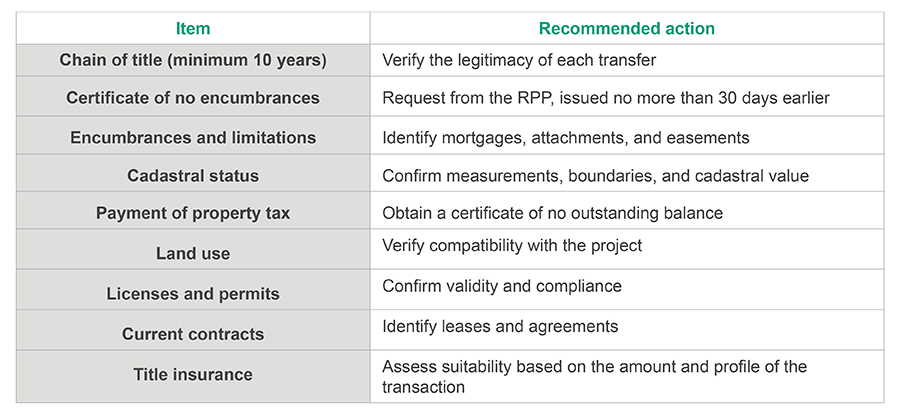
Checklist: best practices
The following is a summary of the main items to be verified in any real estate due diligence review:
Special considerations for properties with an agrarian history (enhanced due diligence)
When a property has an agrarian history—that is, when at some point it formed part of an ejido or agrarian community and was subsequently removed from the social ownership regime—it is essential to conduct an enhanced due diligence or enhanced legal audit. This review must ensure that all requirements established under the Agrarian Law for the removal and transfer of ejidal or communal land from that regime were strictly satisfied, including, among others: (i) adoption of full ownership by the Ejidal assembly with the formalities required by law; (ii) issuance of the corresponding title deed by the National Agrarian Registry; (iii) deregistration of the property from the National Agrarian Registry and its registration with the Public Registry of Property; and (iv), where applicable, respect for the right of first refusal of the ejidal landholder’s family members, the ejido itself, and the residents of the ejido.
It is essential to bear in mind that actions for nullity in agrarian matters brought by ejidal landholders, communal landholders, or agrarian communities are not subject to a statute of limitations under Mexican law, meaning they may be brought at any time without temporal limitation. This characteristic represents a latent and ongoing risk for the purchaser if any irregularity occurred in the process of removal from the social ownership regime, even if many years have elapsed since the original transfer. Accordingly, in transactions involving properties with this type of history, it is advisable to exercise heightened caution, conduct a comprehensive review of all agrarian documentation, consider obtaining title insurance that specifically covers contingencies of agrarian origin and, where appropriate, obtain specialized agrarian-law opinions confirming the regularity of the chain of transfers since the property was removed from the ejidal regime.
Contacts



-
+52 55 5029 8500
-
+52 81 8153 3900
-
+52 442 296 6400


-
+52 55 5029 8500