Public and private sectors discuss regulatory challenges to move towards more sustainable business models
In the latest of the “Garrigues Sustainable Dialogues” webinars, experts from the public and private sectors agreed that the demands of transparency and traceability have already been assumed by large companies
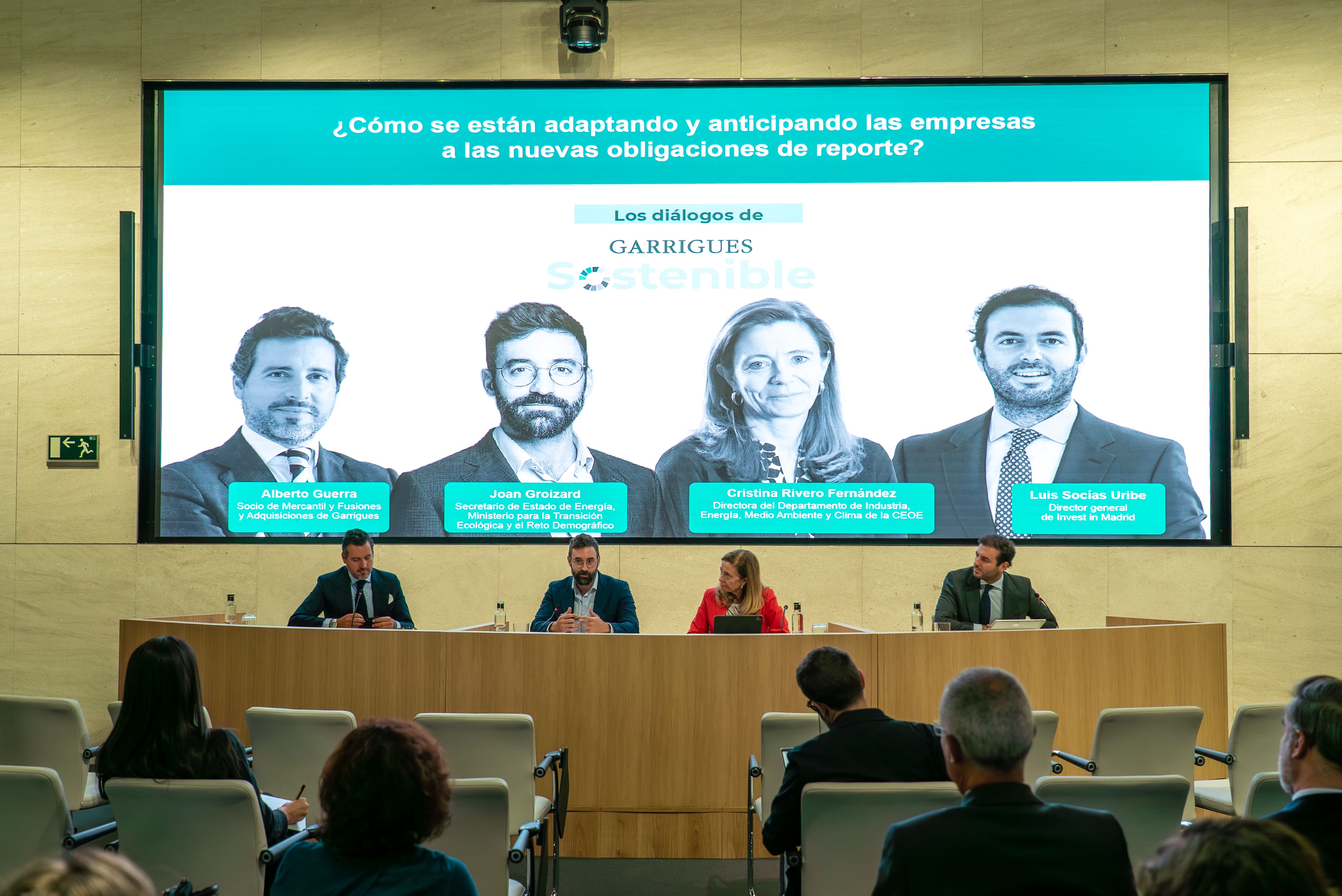
More than 600 people participated online (in addition to the guests present in person in the auditorium) in the latest edition of the "Garrigues Sustainable Dialogues” webinar series, entitled "How are companies adjusting to and anticipating the new reporting obligations?". The forum provided a space in which to analyze the regulatory and legislative challenges faced by companies in their transition to more sustainable models.
The event brought together four keynote speakers who analyzed the legislative challenges, reporting requirements and the role of the private sector in the energy transition.
Alberto Guerra, Corporate and M&A partner at Garrigues, started off the event by drawing attention to the current regulatory situation and the need for spaces such as this forum in which to analyze the challenges and opportunities faced by companies. "We have come to something of a pause in regulatory terms and this brings uncertainty with respect to the implementation deadlines, although it also gives us the opportunity to reflect on how to move forward," he remarked.
Joan Groizard, Secretary of State for Energy at the Ministry for the Ecological Transition and the Demographic Challenge, addressed the global dynamics in decarbonisation and Spain's role in the energy transition. He stressed the need to continue defending the multilateral framework and opted to maintain the level of ambition at the next COP30, which is being held in Belem (Brazil). The secretary recalled the opportunity represented by the advance of decarbonization, not only in terms of sustainability and public health, but also in terms of competitiveness, attraction of industrial projects and job creation. "Our emissions intensity fell by 3.3% compared to 2024, consolidating a positive trend that shows that it is possible to decouple economic growth from the increase in emissions," he said.
Cristina Rivero Fernández, director of the Department of Industry, Energy, Environment and Climate at the Spanish Confederation of Business Organizations (CEOE) , focused on business transparency and the risk of greenwashing. "There is a growing awareness that communication is not possible without there being a methodology behind it", she said. She also mentioned the use of tools such as InfluenceMap to assess the alignment of companies with the Paris Agreement, and how this affects corporate reputation: "Large companies have already firmly assumed the demands placed on them".
Rivero warned about the public and regulatory scrutiny around the veracity of the information reported: "We are seeing increasing litigation in the green field, affecting both companies and governments. That only happens if it is understood that these statements have value."
Luis Socías Uribe, director general of Invest in Madrid, provided the benefits of his experience in attracting European investment and funds. He stressed the importance of defining enabling conditions allowing the private sector to scale up sustainable projects: "There are already many projects under way which are aimed at the COP objectives of doubling renewables and tripling energy efficiency."
The current regulatory uncertainty and its impact on listed companies were also addressed during the webinar. "Once there is framework in place, it is hard to imagine anyone reneging completely," it was remarked at the forum in reference to the reporting obligations under the CSRD.
The event ended with a thank you to the speakers and with a commitment on the part of Garrigues to continue supporting companies in their transition towards sustainability. According to the firm, "reporting obligations are just the tip of the iceberg of what needs to be done”.
Contact