Portugal introduces a new regime for the dynamic management of grid injection capacity in renewable energy projects
Government approves supplementary regime to Decree-Law No. 15/2022, introducing mechanisms for the reconfiguration, transfer and utilisation of grid injection capacity already allocated to renewable electricity generation projects.
Decree-Law No. 100/2026 (DL 100/2026) was published in the Official Gazette on 22 May, establishing a supplementary regime to Decree-Law No. 15/2022 of 14 January applicable to the dynamic management of grid injection capacity on the public electricity network (RESP) following the allocation of a capacity reservation title (TRC). The legislation introduces mechanisms that allow for greater flexibility in reorganising already allocated capacity, including through division, consolidation, waiver, exchange, assignment and amendment of certain elements of the TRC, with the aim of promoting more efficient utilisation of available capacity and greater adaptability in the execution of projects.
Division and consolidation of TRCs
DL 100/2026 provides for and regulates the possibility of dividing certain TRCs into two or three separate certificates, with allocation of the injection capacity across distinct projects (division), as well as concentrating two or more TRCs into a single certificate whilst maintaining the total allocated capacity (consolidation). In both cases, the legislation seeks to reconcile greater flexibility in structuring projects with the preservation of applicable deadlines, obligations already assumed and grid security.
The division of TRCs is subject to the following conditions:
- For connections to the National Transmission Grid, the injection capacity of the TRCs must be at least 50 MVA.
- Division may only apply to TRCs allocated under the grid operator agreement modality.
- It requires identity between the holder of the original TRC and the holder of the TRCs resulting from the division.
- The injection capacity of the TRCs resulting from the division must together equal the injection capacity of the original TRC.
- The obligations of the holder of the TRCs resulting from the division and the conditions to which it has committed shall be maintained and must be set out in the resulting TRC.
- The holder shall be required to make part of the allocated capacity available for assignment to third parties.
Consolidation of TRCs, in turn, is subject to the following conditions:
- Consolidation may only apply to TRCs allocated under the general access and grid operator agreement modalities.
- It requires identity between the holder of the original TRCs and the holder of the TRC resulting from the consolidation.
- The injection capacity of the TRC resulting from the consolidation must equal the combined injection capacity of the original TRCs.
- The applicable deadlines, in particular the deadlines for requesting and issuing prior control permits, shall remain unchanged and shall run from the date of issue of the original TRC.
- The holder shall be bound by the same obligations and the TRC(s) resulting from the division or consolidation shall be subject to the conditions of the original TRC(s).
- The obligations of the holder of the TRC resulting from the consolidation and the conditions to which it has committed shall be maintained and must be set out in the TRC resulting from the consolidation.
- The point of interconnection of the TRC resulting from the consolidation must belong to the same grid.
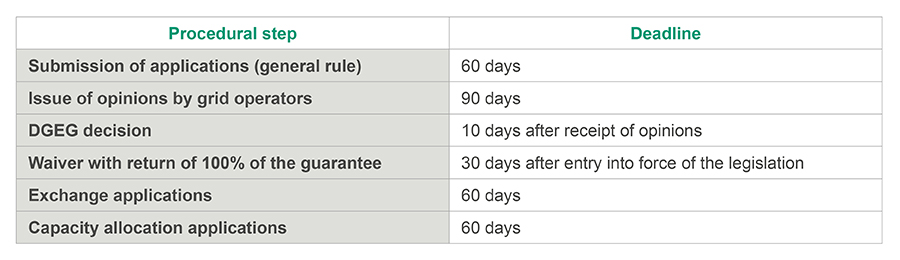
Applications for division and consolidation shall be submitted to the DGEG, which shall decide following a binding opinion from the relevant grid operator. The issue of the new certificates or, where applicable, the execution of the corresponding agreements shall result, pursuant to the legislation, in the release of the guarantees originally provided.
Waiver and exchange of TRCs
TRCs allocated under the general access modality may be subject to waiver, in whole or in part, prior to the issue of the generation licence, by means of an application addressed to the DGEG.
The approval of the application shall produce, in particular, the following effects:
- The lapse of the TRC in respect of the waived portion.
- The immediate availability of the waived capacity for new allocation.
- The return to the holder of 80% of the value of the guarantee corresponding to the waived capacity, with the remaining 20% reverting to the general charges of the national electricity system.
- If the application is submitted within 30 days of the entry into force of the legislation, the return shall correspond to 100% of the value of the guarantee relating to the waived capacity.
On the other hand, TRCs allocated under the grid operator agreement modality may be subject to exchange through the swap of the contractual positions assumed by the respective holders in the agreements entered into with the (same) grid operator.
The exchange of TRCs is subject to the following conditions:
- The points of interconnection set out in the TRCs to be exchanged must belong to the same grid.
- The injection capacity of the TRCs resulting from the exchange may not exceed the combined injection capacities of the TRCs to be exchanged.
- The obligations of the holders of the TRCs to be exchanged and the conditions to which they have committed shall be maintained and must be set out in the TRCs resulting from the exchange.
- The application must be submitted within 60 days of the date of entry into force of the legislation.
Assignment of injection capacity
The legislation also permits holders of TRCs allocated under the grid operator agreement modality to declare part of their available injection capacity as available for assignment to third parties, subject to authorisation from the DGEG and a binding opinion from the relevant grid operator.
The declared available capacity may be used to satisfy requests for the execution of an agreement between the interested party and the RESP operator which have not yet been subject to a grid study. Interested parties must submit a capacity allocation application within 60 days of the entry into force of the legislation, failing which the application for execution of the agreement shall lapse.
TRC reconfiguration mechanisms
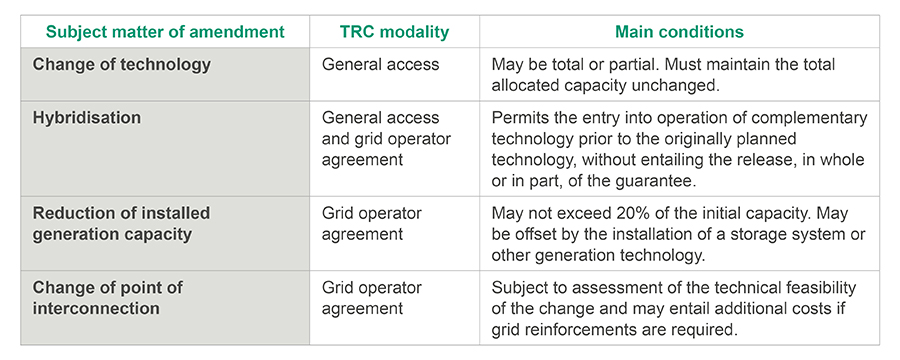
DL 100/2026 provides for various mechanisms for the flexibility of TRCs in respect of technology, capacity and point of interconnection. In summary:
Procedural deadlines
Entry into force
The legislation entered into force on the day following its publication and shall remain in force until 30 June 2027.
Contacts