

Polish tax reform for 2027: higher CIT for the largest taxpayers and changes to PIT

Proposed changes to Poland’s income tax rules could increase the tax burden on some businesses from January 1, 2027. The PIT scale and the rules governing the flat-rate tax on recorded revenue are also set to change.
Poland is currently working on three bills that would significantly change the taxation of businesses and individuals from 2027. The changes cover, among other things, CIT, PIT, the flat-rate tax on recorded revenue and certain energy-sector companies. Although each bill addresses a different area, together they form a single reform package.
The proposed PIT cuts are to be funded mainly by a higher CIT rate for the largest taxpayers and by restricting access to flat-rate tax. The Ministry of Finance considers the package to be budget-neutral:
- UD458 – a bill amending the PIT Act, the CIT Act and the Flat-rate Income Tax Act. The Council of Ministers has already adopted the bill and submitted it to the Sejm (Sejm Print No. 3147). It provides, among other things, for a 22 % CIT rate and a new PIT scale.
- UD459 – a bill on support for energy-intensive businesses facing electricity costs (Sejm Print No. 3159). It provides for a temporary CIT increase for the largest entities in the fuel, gas and energy sectors. The proceeds are to fund a PLN 4.8 billion support program for 2027–2030.
- UD116 – a bill amending the PIT Act, the CIT Act and certain other acts. Among other things, it changes the minimum income tax. The Council of Ministers has already adopted the bill and submitted it to the Sejm (Sejm Print No. 3137).
The final wording of the provisions may still change as the bills progress through Parliament. January 1, 2027 remains the target date, so the legislative process should be monitored closely.
Bill UD458: higher CIT for the largest taxpayers and changes to PIT and the flat-rate tax
22 % CIT rate for entities with revenue above EUR 50 million
Bill UD458 would raise the CIT rate from 19 % to 22 % for two groups of taxpayers:
- taxpayers whose revenue in the previous tax year exceeded the equivalent of EUR 50 million;
- taxpayers that, on any day of the tax year immediately preceding the tax year concerned, were constituent entities of groups subject to the Act on Top-Up Taxation of Constituent Entities of Multinational and Domestic Groups (Pillar Two), regardless of their revenue.
The 22 % rate will not replace the special rates for banks under Article 19(1)(3) and (4) of the CIT Act, but it may apply to the remaining part of the tax base of a tax capital group that includes a bank.
For all other businesses, the 19 % and 9 % rates will remain unchanged. According to the explanatory memorandum, the measure is intended to increase the contribution of the largest entities to public spending.
Importantly, the EUR 50 million threshold refers to revenue and only determines whether a taxpayer is subject to the higher rate. The 22 % rate itself applies to the tax base, i.e., generally to taxable income rather than total revenue. The threshold will be converted at the average National Bank of Poland (NBP) exchange rate on the last business day of the previous tax year, rounded to the nearest PLN 1,000.
For taxpayers whose tax year is the calendar year, revenue earned in 2026 will determine the rate applicable in 2027. Businesses close to the EUR 50 million threshold should therefore review their revenue forecasts now.
Implications for Pillar Two
A higher statutory rate does not change the design of the GloBE rules, i.e., the global minimum tax under Pillar Two. It may, however, raise the effective tax rate of Polish constituent entities and thus reduce any qualified domestic minimum top-up tax (QDMTT) payable in Poland. The impact will depend on each entity’s circumstances, including its use of tax incentives such as those available in the Polish Investment Zone. Groups within the scope of Pillar Two should therefore factor the planned changes into their effective tax rate modeling and forecasts of future tax liabilities.
Changes to PIT and the flat-rate tax on recorded revenue
Bill UD458 would also introduce a three-bracket tax scale with rates of 12 %, 24 % and 32 %. The new scale would apply only if the CIT and flat-rate tax provisions intended to fund it enter into force on January 1, 2027:
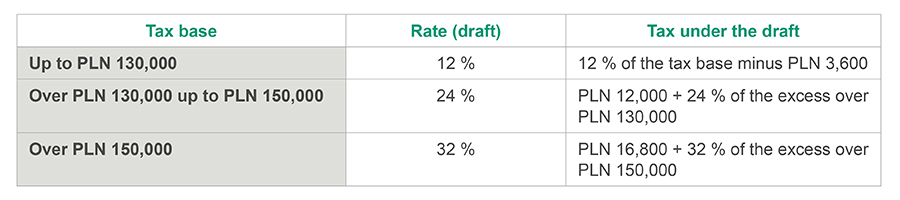
The bill does not change the tax-free allowance, which currently stands at PLN 30,000.
The bill would also raise the solidarity levy, charged on annual income above PLN 1 million, from 4 % to 5 %. The new rate would apply to the levy payable in 2028, i.e., on income reported in 2027 tax returns.
The revenue threshold for opting into the flat-rate tax on recorded revenue would be lowered from EUR 2 million to EUR 250,000. Certain revenue earned during the year in excess of EUR 300,000 would be taxed at 17 %. As with CIT, revenue earned in 2026 will be decisive: a taxpayer will be able to opt for the flat-rate tax for 2027 only if its 2026 revenue does not exceed the equivalent of EUR 250,000.
The planned PIT and CIT changes are closely linked, as raising the CIT rate to 22 % for the largest taxpayers is intended to be the main source of funding for the PIT scale reform.
Bill UD459: temporary CIT increase in the fuel, gas and energy sectors
Bill UD459 would temporarily apply higher CIT rates to taxpayers with revenue above EUR 50 million that carry out certain activities and meet additional conditions concerning the share of revenue from those activities and their group membership. The group membership condition will not apply to taxpayers whose revenue in the previous tax year exceeded EUR 750 million. Where that share is at least 33 % but below 75 %, the higher rate will apply to a proportionate part of the tax base. The activities concerned include:
- natural gas and crude oil extraction,
- trading in and production of gaseous and liquid fuels,
- electricity transmission,
- electricity distribution, except by vertically integrated undertakings.
The rules will also cover tax capital groups that include a company carrying out such activities.
The rate would generally be 30 %, 26 % and 23 % for tax years beginning in 2027, 2028 and 2029, respectively. The bill provides for adjustments where the tax year is changed or extended, and for a given rate to continue to apply in subsequent tax years if, at the end of the previous year, it had applied for a total of less than 12 consecutive calendar months. The higher rates could therefore remain in place after 2029. The mechanism is modeled on the approach previously adopted for the banking sector.
Bill UD116: exemption from the minimum income tax
Bill UD116 would exempt from the minimum income tax taxpayers whose operating revenue derives mainly from the sale of electricity, heat or piped gas. The exemption is justified by the sector’s heavy regulation, market volatility and the risk of the tax being passed on to end consumers through higher prices.
Summary
The planned changes could significantly increase the tax burden on the largest companies. Fuel, gas and energy companies would be hit hardest, with a CIT rate of up to 30 % in 2027. The bills also cover the minimum income tax, the PIT scale, the solidarity levy and the flat-rate tax. Their impact therefore goes beyond ordinary tax compliance and may also affect remuneration policies, business financing and intra-group settlements.
Contact

