

Mexico issues new regulation for the monitoring and control of pollutant emissions at gas stations
This new regulation is implemented in line with other actions of the Mexican Government aimed at consolidating the protection of the environment, people and natural resources, as well as the traceability of petroleum products, in this case, by regulating hydrocarbon sector facilities.
On July 17, 2025, the National Agency for Industrial Safety and Environmental Protection of the Hydrocarbons Sector (ASEA) published in the Official Gazette of the Federation (DOF) the resolution for the control and monitoring of pollutant emissions into the atmosphere to be observed by regulated gas stations for the sale of gasoline and/or diesel to the public.
The agreement is of general observance and mandatory throughout the national territory for permit holders that sell the referred oil-refined products in gas stations to the public. Specifically, its purpose is to establish the specific control and monitoring actions to be implemented by such permit holders for the prevention and reduction of emissions of pollutants into the atmosphere, such as sampling the petroleum products in the storage tanks of the gas stations, since the use of biofuels and additives modifies the vapor pressure of the oil-refined products, which impacts their volatility and leads to an increase in evaporative emissions.
Storage Tank Sampling
For sampling, one of the following methods established in current regulations shall be applied:
- Manual Sampling: ASTM D4057 method (Manual Sampling of Petroleum and Petroleum Products); or
- Automatic Sampling: ASTM D4177 method (Automatic Sampling of Petroleum and Petroleum Products).
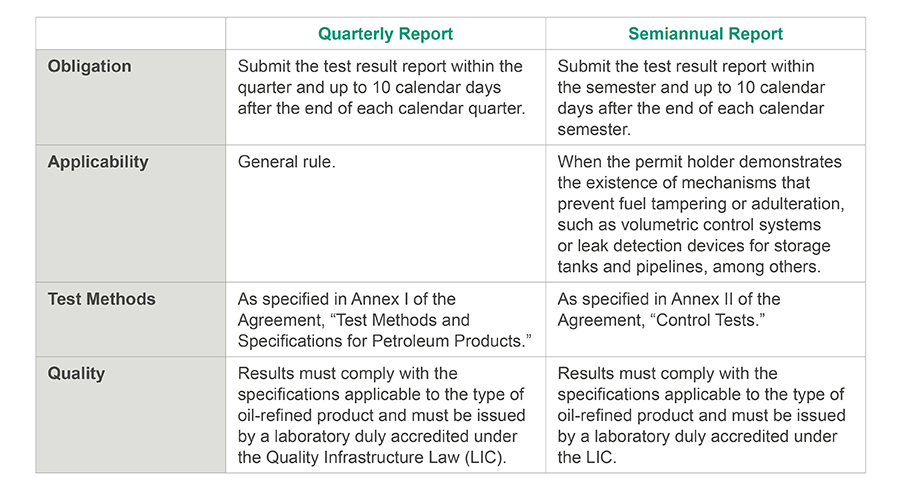
Once sampling is completed, regulated parties must submit the test result reports to ASEA via the Electronic Filing Office (OPE) either quarterly or semiannually, depending on the applicable case.
Additional Considerations
- For purposes of the reports to the ASEA, the regulated parties may also make use of the alternative test methods referred to in the agreement.
- As an additional obligation, the regulated parties must have a document in which the quality specifications of the gasoline and/or diesel derived from the corresponding results report for each lot, in accordance with the licensed activity from which it originates.
- Some of the specifications of the oil-refined products will be determined by geographic zones, season and regions, so it is important to review the annexes of the agreement.
- The information submitted by the regulated parties in compliance with the agreement will be considered public information, except for the cases provided by the legislation on transparency, access to information and data protection.
- As long as the OPE is not available, the regulated parties must submit their reports to the ASEA's regulated party service area within the corresponding periods.
- The agreement became effective on July 18, 2025, one day after its publication in the DOF.
Contacts


-
+52 55 5029 8500

-
+52 55 5029 8500

-
+52 55 5029 8500

-
+52 55 5029 8500