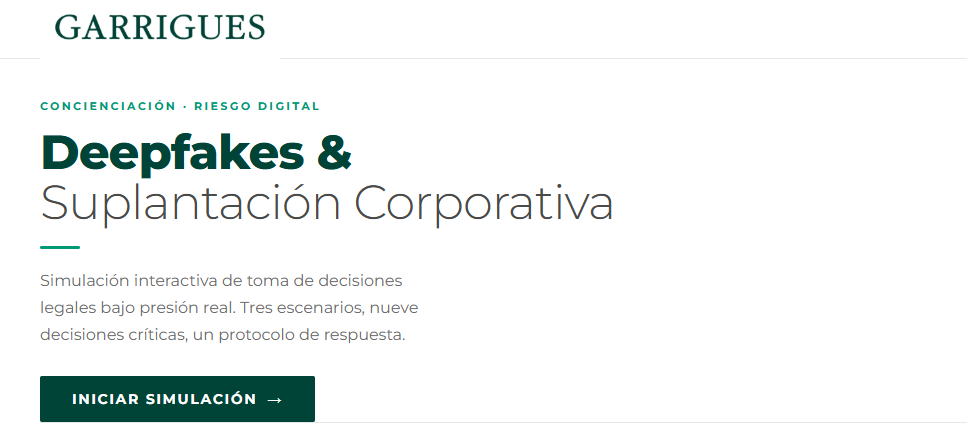
These scenarios, increasingly realistic and frequent, require prior preparation and the ability to respond immediately. With this in mind, as the closing piece in our series on deepfakes and synthetic content, Garrigues has developed an interactive simulator designed to train real-time decision-making in digital identity crises.
A cloned voice of your CEO instructs a €480,000 transfer. A fake video of the managing director goes viral and hits the company’s share price. Fraudulent ads hijack your brand on social media. What would you do in the first few minutes?
Deepfakes and corporate impersonation have gone from a theoretical threat to an everyday risk for companies and executives. Artificial intelligence can now replicate a voice, a face, or a brand with a level of realism that undermines traditional controls. The response must therefore be prepared in advance and from a dual technical and legal perspective (always applying common sense).
In recent weeks, Garrigues Digital has published a series of articles (see here) analysing, from different angles, the legal challenges posed by synthetic content. As the final instalment, Garrigues has developed an interactive simulator that puts you in the role of the person who must make decisions once a crisis has already erupted. Across three scenarios (CEO fraud using a cloned voice, a fake video affecting share price, and an advertising campaign that misappropriates the company’s identity), you will face nine critical decisions under real pressure: blocking, verifying, preserving evidence, communicating, reporting… After each choice, you immediately receive the legal reasoning behind it (criminal liability, data protection, intellectual property, and chain of custody of digital evidence). At the end, you will receive your score and the key elements of the response protocol.
This is not a theoretical test –it is training for executives, legal advisers, compliance officers, and any professional who wants to test their reflexes in a digital identity crisis, where every second counts.
Want to try it? You can start here: